Every winter, divers from around the world look forward to eagle ray season in Cozumel, a magical time when the island’s reefs welcome one of the most elegant and mesmerizing animals in the Caribbean: the spotted eagle ray. Between December and March, cooler currents sweep along the island and bring in these stunning rays in greater numbers, creating one of the most unforgettable dive experiences Cozumel has to offer.
Whether you’re planning your first trip or returning for another winter of drift diving, this guide will show you what makes eagle ray season so special, which reefs offer the best chances of sightings, and why this is the perfect time to book your next adventure with Sand Dollar Sports.
Table of Contents
What Is an Eagle Ray? Meet Cozumel’s Winter Visitor
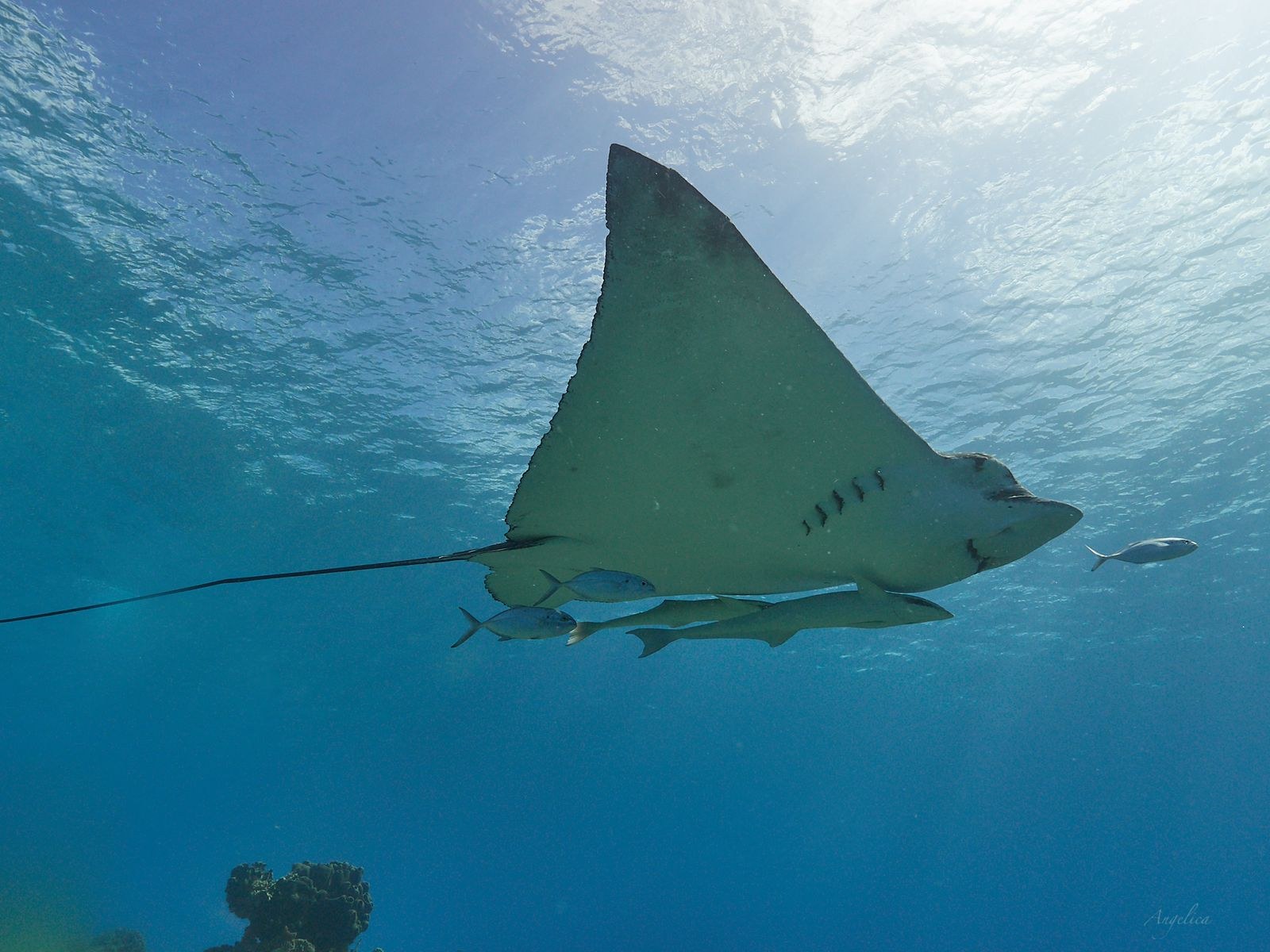
The spotted eagle ray (Aetobatus narinari) is a diamond-shaped ray with long, graceful wings and a striking pattern of white spots scattered across a dark back. Every pattern is unique, giving each ray its own “fingerprint.” They glide through the water with slow, sweeping fin movements that look like they’re literally flying beneath the waves — one reason divers love them so much.
Adult spotted eagle rays are pretty large, achieving a body width of up to 10.8 feet (3.3 m). With their tail fully intact, their total length can measure 16.4 feet (5 m), and their maximum reported weight is 507 pounds (230 kg). They’re ovoviviparous, meaning the embryos develop inside eggs that hatch within the mother, and she gives birth to live young. Sadly, eagle rays are now considered near threatened on the IUCN Red List of Threatened Species.
Eagle rays use their pointed snout to forage in sand, searching for clams, conch, crabs, and small invertebrates. They give birth to live young, and though they normally travel alone, winter brings something extraordinary to Cozumel: groups of eagle rays gliding together through blue water. A group of eagle rays is called a fever, a perfect name for the thrill divers feel when they appear.
Eagle Ray gliding over the sand in Cozumel with two permitfish.
Checkout our Underwater Images page to see some of the marine life you will likely come across when diving in Cozumel.
When Is Eagle Ray Season in Cozumel?
Eagle ray season in Cozumel runs from December through March, with sightings often continuing into early April. This is when cooler currents push nutrient-rich water along the island’s northern and western shores, creating perfect conditions for eagle rays to feed and travel.
Did you know that Cozumel is the drift diving capital of the world? You can learn more about drift diving in Cozumel in this blog.
Where to See Eagle Rays in Cozumel
While eagle rays can appear almost anywhere during the winter, these reefs are known as the hot spots:
Cantarel (Eagle Ray Wall)
The crown jewel of eagle ray season in Cozumel, Cantarel is famous for sightings of multiple rays flying along the wall in formation. Strong currents make this an advanced dive, but the rewards are spectacular. There are only a few dive centers in Cozumel that make trips there because it is a long trip, and only advanced divers are qualified to dive there due to the powerful currents on that reef.
Santa Rosa Wall
A Cozumel classic. Winter visitors frequently see eagle rays cruising the drop-off as they drift along. Intermediate to advanced level divers. There are strong currents and a deep wall drop-off.
Punta Tunich
Fast currents, excellent drift, and regular winter encounters make Punta Tunich a top dive site during eagle ray season. Intermediate to advanced divers recommended.
La Francesa
Shallower and calmer, ideal for divers who prefer a relaxed drift while still hoping to encounter rays. This dive site is suitable for divers of all levels.
Villa Blanca Reef
Villa Blanca Reef is located in front of Sand Dollar Sports Dive Center in Cozumel. There is a shallow reef and a deeper reef with a wall dive. This reef is a corridor between the northern and southern reefs so it is not uncommon to see eagle rays that are moving between reefs.

Get to know these and other sites on our Cozumel Dive Sites page.
Why Eagle Ray Season in Cozumel Is So Special
- High likelihood of sightings — winter is the best chance all year.
- Fever formations — watching multiple rays glide in formation is unforgettable.
- Stunning conditions — clear water, energized drift diving, and beautiful winter light.
- Nature-friendly tourism with Sand Dollar Sports — diving with us supports local conservation efforts.
Ready to dive these sites? Explore our Boat Dive Packages!
Dive Responsibly During Eagle Ray Season
Eagle rays are sensitive animals. To keep them safe:
- Maintain buoyancy control
- Do not chase or touch
- Give them space to pass naturally
- Follow Cozumel Marine Park rules:
- 1. Keep a distance of 1.5 meters from the reefs.
- 2. Do not feed the marine life.
- 3. Only hire boats and guides authorized by CONANP. If unsure, ask them for their permit number.
- 4. Anchoring is prohibited.
- 5. Do not touch the reefs.
- 6. Do not use sunscreen. Any type of sunscreen is prohibited to protect the corals.
- 7. Do not disturb marine life.
- 8. Do not fish.
- 9. Do not use gloves, knives, or rods.
Responsible diving ensures that eagle rays return to Cozumel year after year.
Join Us for Eagle Ray Season in Cozumel — and Get 10% Off
There’s no better way to experience eagle ray season in Cozumel than drifting along our vibrant reefs with a fever of eagle rays gliding beside you. Whether you’re an experienced diver or exploring Cozumel’s reefs for the first time, Sand Dollar Sports offers safe, professional, and personalized dive experiences all winter long.
Book any scuba course or dive package with Sand Dollar Sports now through March and enjoy 10% off—plus the chance to see an eagle ray in season! Use coupon code: EAGLERAY at checkout.
👉 Scuba Diving Courses
👉 Dive Packages
Frequently Asked Questions
When is eagle ray season in Cozumel?
Eagle ray season in Cozumel runs from December through March, with sightings often continuing into early April. During these winter months, cooler currents attract higher numbers of spotted eagle rays to the reefs, giving divers some of the best chances of encounters all year.
What is a group of eagle rays called?
A group of eagle rays is called a “fever.” Divers occasionally see fevers of eagle rays gliding together in formation, especially during peak winter months.
Can new divers dive during eagle ray season in Cozumel?
Yes. While some dive sites with strong currents are better suited for experienced divers, beginners can still enjoy eagle ray season. Sites like La Francesa offer calmer conditions that are perfect for new divers when accompanied by a certified guide.
How large do eagle rays get?
They can grow over 10 feet wide and over 16 feet long, and they can reach a weight of 507 pounds!